
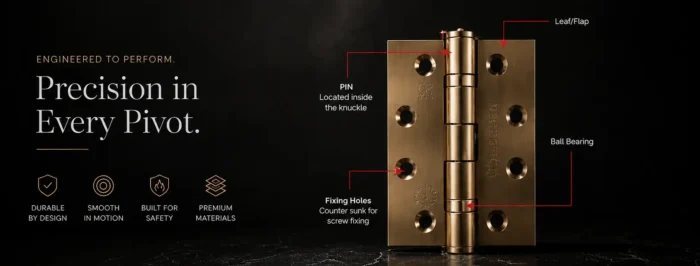
In high-end architectural design, the difference between a project that ages and one that endures lies in the hardware. Door hinges are the silent workhorses of the built environment. Beyond simple aesthetics, they are precision-engineered components responsible for structural integrity, fire safety, and long-term operational performance.
This guide explores the technical specifications of door hinges, focusing on the materials and mechanics required for high-traffic and high-specification environments.
-
Why Specification Matters: Beyond the Pivot
A door hinge is a mechanical bearing that manages the static load (door weight) and dynamic stress (frequency of use). Choosing a sub-specification hinge leads to “door drop,” misalignment, and compromised security.
For professional projects, hinges are categorized by their Grade under standards like EN 1935. A Grade 14 hinge, for example, is tested to withstand 500,000 cycles and a door weight of up to 160kg, making it the benchmark for commercial durability.
-
Types of Architectural Hinges
Understanding the mechanical application is the first step in hardware scheduling:
- Ball Bearing Hinges: The industry standard for heavy-traffic zones. The internal bearings reduce friction, ensuring a silent, smooth swing even for high-mass doors.
- Concealed 3D Adjustable Hinges: The choice for modern, minimalist interiors. These are invisible when the door is closed and allow for precision alignment on the vertical, horizontal, and depth axes.
- Spring Hinges: Engineered with internal tension to ensure automatic closing, often used in fire-safety applications where a door must return to its frame.
-
Material Science: Grade 304 vs. Grade 316 Stainless Steel
In the architectural hardware world, the material is the most critical factor for longevity, especially in challenging climates.
- Grade 304 Stainless Steel: The standard for interior commercial and residential use. It offers excellent durability and corrosion resistance in controlled environments.
- Grade 316 Stainless Steel (Marine Grade): Essential for coastal regions or areas with extreme environmental stressors. Grade 316 contains Molybdenum, providing superior resistance to “tea-staining” and pitting caused by high salinity and temperatures exceeding 50°C.
- Solid Brass: Preferred for luxury residential projects where a bespoke aesthetic is required. Brass is naturally rust-proof but is typically reserved for lower-frequency interior use compared to steel.
-
Fire Safety and Compliance
Hinges are a critical component of a fire-door assembly. To remain compliant with building regulations, architectural hinges must be:
- Fire-Rated: Tested to maintain structural integrity at high temperatures for 30, 60, or 120 minutes.
- Properly Shielded: In timber fire doors, intumescent pads must be installed behind the hinge leaves to prevent heat transfer and seal the mortise during a fire event.
-
Factors for Precision Selection
When specifying hardware for your next project, use this checklist to ensure technical accuracy:
- Door Mass: Calculate the total weight, including glass, handles, and closers.
- Environmental Exposure: Determine if the site is inland, coastal, or high-humidity.
- Frequency of Use: Categorize the door as low, medium, or high-traffic (e.g., an office entrance vs. a private bedroom).
- Aesthetic Continuity: Match finishes across hinges, levers, and escutcheons for a cohesive “Sensorial Engineering” experience.
Final Thoughts
Investing in high-specification architectural hinges is a commitment to both design and durability. Whether you are specifying for a luxury villa or a high-rise commercial tower, selecting the correct material – such as Grade 316 Stainless Steel – ensures that the project remains as functional and beautiful in ten years as it was on opening day.