
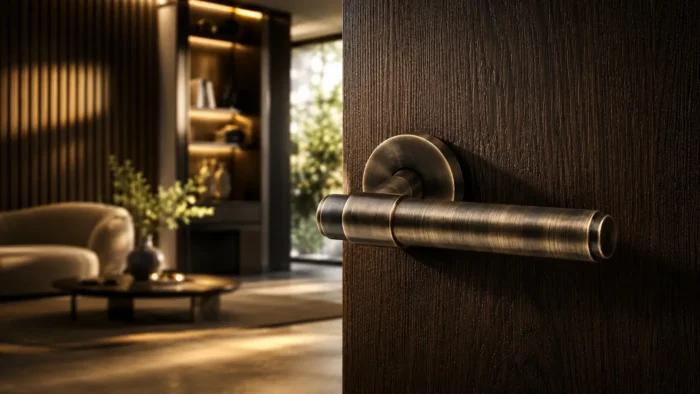
When people think about luxury interiors, they often focus on what they can see — marble finishes, handcrafted woodwork, designer lighting, and premium architectural hardware. But true high-end design goes far beyond appearance. The finest spaces are not only visually beautiful; they are emotionally experienced through every sense.
One of the most overlooked aspects of luxury living is sound.
Traditional marketing focuses on how a handle looks, but premium architectural hardware is also about how it feels and sounds during everyday use. The subtle click of a solid brass latch, the silent movement of a precision-engineered hinge, and the controlled closing of a luxury door create an experience that instantly communicates quality.
In luxury automotive design, the “thud” of a car door closing is a billion-dollar industry. Automotive engineers spend years refining acoustic performance because sound influences perception. A weak, hollow sound suggests poor construction, while a deep, controlled closure signals durability, safety, and sophistication.
Why should your home be any different?
Today, architects, interior designers, and homeowners are increasingly embracing sensorial design — the art of creating environments that engage every sense. In this movement, architectural hardware plays a surprisingly important role.
Why Sound Matters in Interior Design
Human beings instinctively associate sound with quality. Even without consciously realizing it, we judge products based on acoustic feedback. A flimsy cabinet hinge, a rattling door handle, or a loud latch mechanism immediately diminishes the feeling of luxury within a space.
High-end hardware manufacturers understand that silence and precision are essential components of premium design.
This is where silent luxury enters the conversation.
Silent luxury is not about flashy aesthetics or excessive ornamentation. Instead, it focuses on subtle refinement, technical precision, and seamless user experience. The quiet confidence of a perfectly engineered mechanism often says more about quality than visual decoration ever could.
In modern luxury homes, acoustic performance has become just as important as visual harmony.
The Science Behind Acoustic Performance in Architectural Hardware
The sound produced by architectural hardware is never accidental in premium products. Every movement — whether opening a cabinet, turning a lever handle, or closing a door — is engineered to create a controlled sensory experience.
This requires advanced sound engineering and precision manufacturing.
Silent Hinges: Engineering Quiet Motion
One of the clearest examples of acoustic performance is found in silent hinges.
Mass-market hinges often produce squeaking, vibration, metal friction, or abrupt closing sounds over time. These noises occur because of inferior materials, loose tolerances, and poorly designed internal mechanisms.
Premium silent hinges operate differently.
High-end hinges are manufactured using advanced bearing systems, precision alignment, and dampened movement technology. Many include concealed lubrication systems that reduce friction while maintaining smooth motion for years.
The result is almost effortless movement with virtually no audible disturbance.
In luxury interiors, this silent operation contributes to a calm and sophisticated environment. Whether used in master bedrooms, executive offices, designer wardrobes, or bespoke kitchens, silent hinges enhance the overall emotional quality of a space.
This level of technical precision transforms a simple functional component into a refined sensory experience.
The Weighted “Click” of Solid Brass Latches
Another defining characteristic of premium architectural hardware is the sound of the latch mechanism.
Cheap hardware typically produces a sharp, hollow, or metallic noise during operation. These sounds often feel abrupt and unsatisfying because lightweight alloys and weak internal springs fail to provide controlled movement.
In contrast, solid brass latches create a deep, weighted click that communicates durability and craftsmanship.
This distinctive sound comes from a combination of material density, internal balance, and mechanical precision. Brass naturally absorbs vibration more effectively than low-cost metals, reducing harsh resonance while creating a smoother acoustic profile.
The latch does not simply close — it settles into place with confidence.
For luxury homeowners, this subtle detail becomes part of the daily living experience. Over time, these moments shape how a space feels emotionally.
The difference may seem minor on paper, but in practice, acoustic refinement has a profound psychological impact.
Eliminating the “Rebound” Sound in Premium Lever Collections
One of the most common flaws in low-quality door handles is the rebound sound.
After operating the lever, mass-market handles often snap back aggressively due to poorly calibrated springs. This creates an unpleasant metallic noise and can eventually loosen internal components.
Premium lever collections solve this problem through carefully engineered internal spring mechanisms.
Instead of abrupt rebound action, high-end handles return smoothly and silently to their resting position. The internal springs are designed with controlled tension, ensuring consistent resistance and balanced motion.
This engineering process requires exceptional manufacturing accuracy because even minor inconsistencies can affect sound, feel, and long-term durability.
The result is a handle that feels substantial, refined, and acoustically balanced every single time it is used.
This is sensorial design at its finest — where touch, motion, and sound work together to create a luxury experience.
Why Architects and Designers Are Prioritizing Sensorial Design
Modern luxury architecture is evolving beyond purely visual trends.
Today’s leading designers understand that true sophistication is experienced holistically. Lighting, texture, temperature, scent, and sound all contribute to the emotional atmosphere of a space.
Architectural hardware sits at the intersection of these experiences.
When every door movement feels smooth, every latch sounds controlled, and every handle operates with silent precision, the entire home feels more intentional and elevated.
This is particularly important in high-end residential projects, luxury hotels, premium offices, and boutique commercial spaces where user experience defines brand perception.
Clients may not consciously identify the source of these details, but they immediately feel the difference.
That feeling is the essence of silent luxury.
Technical Precision Creates Timeless Luxury
Luxury is no longer defined by excess alone. Today, it is defined by refinement.
Premium architectural hardware demonstrates how technical precision can influence everyday experiences in subtle yet powerful ways. From silent hinges to solid brass latches and precision-engineered lever mechanisms, acoustic performance has become a hallmark of sophisticated design.
The best hardware does not demand attention through noise or visual exaggeration. Instead, it creates confidence through flawless operation, controlled sound, and exceptional craftsmanship.
In many ways, the future of luxury interiors lies not only in what we see — but in what we hear.
Because true design excellence is never just visual.
It is sensorial.